
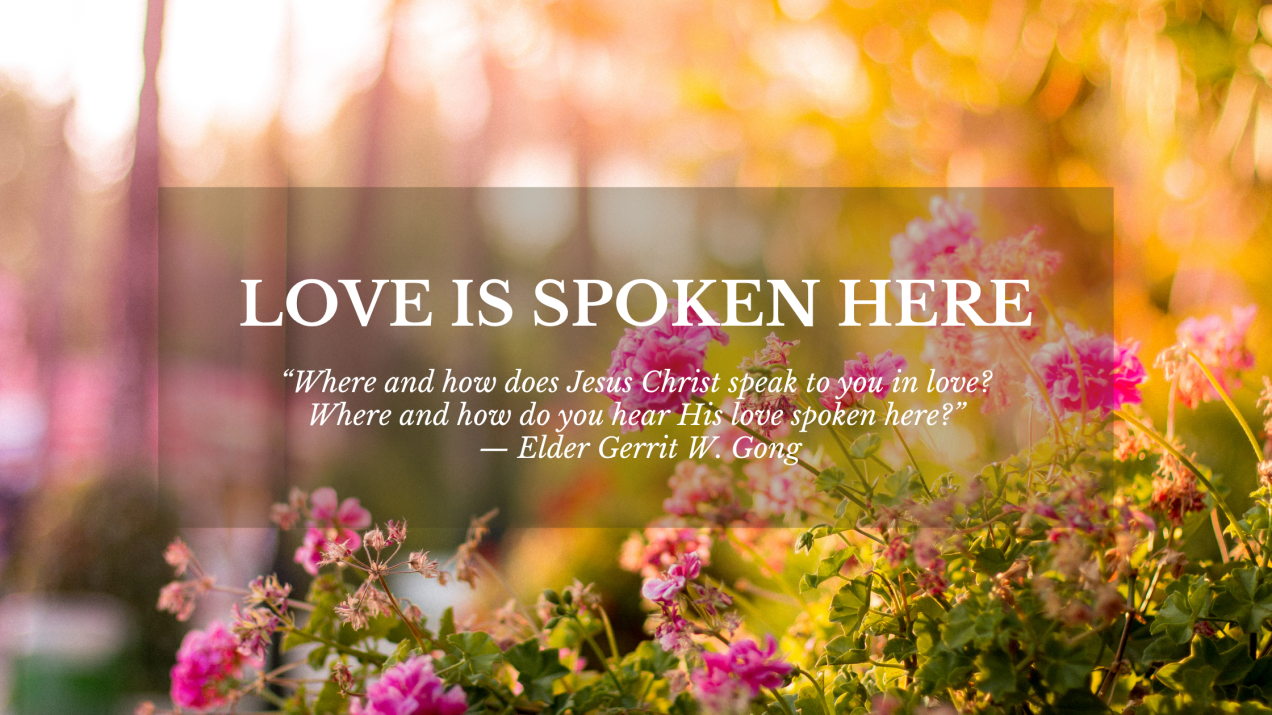
I wrote about Elder Gerrit W. Gong’s talk, “Love Is Spoken Here,” a few weeks ago, and this past Sunday, I felt inspired to revisit it for my sacrament meeting talk—hopefully my last one of the year. 😆 Just documenting another talk for the record!
Brother Chue Feng messaged me on Thursday while I was staring at my work screen at the office, and I thought, “Hmm, he wrote ‘Hey Angela’ with a question mark? What could it be?”
And of course he asked me to give a talk today.
So here I am.
He told me that because it was short notice, if I already had something in mind, I could speak on it. Otherwise, he had a topic for me.
At the time, there actually was something I’d been pondering over the last few days, so I confidently told him, “I have something in mind.”
And then later that evening, as I lay in bed, I wasn’t so sure anymore.
So I went back through my blog and was inspired by a post I had written after a thought came to me rather randomly while I was making my niece learn Primary songs a few weeks ago.
One of the songs I was having her learn was “Love Is Spoken Here,” which reminded me of Elder Gerrit W. Gong’s General Conference message with the same title. It’s from the October 2023 General Conference, so if you missed it, I invite you to go back and listen to it. He shared a beautiful message.
And it got me thinking about the different ways we say, “I love you.”
Some people say it easily. Some show it through service or by remembering the little things. And my favorite—some show it by making sure you’ve eaten.
And some people may never say very much at all, but somehow, you still know.
And that made me wonder:
How does Heavenly Father say, “I love you”?
And maybe more importantly, do we always recognize it when He does?
In his message, Elder Gong speaks about different languages of gospel love, including “the language of warmth and reverence, the language of service and sacrifice, and the language of covenant belonging.”
I love the idea that love can have a language, because language is more than words.
We communicate through what we do—through how we treat one another, whether we listen, whether we remember, and whether we stay.
And I think Heavenly Father often communicates His love in those same quiet ways.
There have been times in my life when I’ve prayed expecting an obvious answer. I wanted Heavenly Father to tell me exactly what to do. I wanted something unmistakable.
And sometimes the answer came.
But other times, nothing dramatic happened.
Instead, someone checked on me.
A scripture suddenly meant something different.
Someone said something at church that I needed to hear.
An opportunity to serve came when I was too focused on my own problems.
Or there was simply enough peace to take another step forward.
Looking back, I can see that there were times I thought Heavenly Father was silent when He had actually been speaking to me all along.
I just hadn’t learned His language yet.
When I look at the Savior’s ministry, one thing that stands out to me is how often Jesus noticed individuals.
He noticed people others overlooked—the sick, the grieving, the lonely, the rejected, the sinner, and the child.
He didn’t simply see crowds.
He saw people.
And I think there is something sacred about helping another person know that they matter.
King Benjamin taught in Mosiah 2:17:
“When ye are in the service of your fellow beings ye are only in the service of your God.”
This connects beautifully with what Elder Gong calls “the language of service and sacrifice.”
Service can be such a powerful language of love because it teaches us to look beyond ourselves and notice people the way the Savior does.
And when we hear the word service, we might imagine something organized—a service project, an assignment, or a meal being delivered.
But service can also be incredibly ordinary.
It can be sitting beside someone who came to church alone.
Sending a message when someone comes to mind.
Listening without immediately trying to fix everything.
Helping without being asked.
Or simply noticing when someone doesn’t seem like themselves.
On the week of Christmas last year, I had an opportunity to experience that kind of simple service when I went caroling with the missionaries to a couple of families.
And we’re hoping to do it again this year, so stay tuned.
We went from home to home singing Christmas hymns. We weren’t doing anything extraordinary. We were simply showing up at people’s doors with Christmas music—and probably some imperfect singing from all of us.
But looking back, I don’t think the most important part was how well we sang.
It was that we thought of them and went to visit.
Each time someone opened their door, there was a simple message underneath what we were doing to remind them that:
“We remembered you.”
“We wanted to see you.”
“You are part of us.”
And just this week, I was reminded of that same kind of love in a different way.
Some of our Young Women and Relief Society sisters went to visit one of our church grandmas, Sister Pa Vang—or as many of us call her, Tais Paj.
She hasn’t been feeling well, and her daughter mentioned that she would appreciate it if some of us sisters visited.
So we did.
We couldn’t take away what she was going through or fix everything.
But we could be there when she needed comfort.
A few days before, I had encouraged our Young Women to learn a little Hmong phrase or sentence before the visit so they could share it with her and uplift her.
We haven’t quite accomplished that part yet, so girls, we’ll have to try again next time. 😆
But as I’ve been thinking about “Love Is Spoken Here,” I realized how fitting that little assignment was.
Sometimes love really is spoken in another language.
But what matters even more is the effort behind the words.
Someone cared enough to learn them—like our wonderful missionaries in the ward.
Someone cared enough to knock on a door and sing.
Someone cared enough to visit and sit for a while.
Someone cared enough to remember.
Both of those experiences reminded me that Heavenly Father doesn’t just tell His children that He loves them.
He lets us help Him show them.
The circumstances may look different, but underneath them is a simple message:
“You haven’t been forgotten.”
I think Heavenly Father sends that same message to us in so many ways—through a friend, a family member, someone in our ward, or even a prompting someone else chooses to follow.
We may never know when something small we do becomes an answer to someone else’s prayer.
I believe that’s one of the ways Heavenly Father speaks His love—through ordinary people who are willing to notice each other.
But sometimes we can recognize His hand in someone else’s life more easily than we can recognize it in our own.
If you know me,I love flowers, so naturally, one of the ways I’ve come to understand that is through looking at a garden. 😆
One thing I love about gardens is that they don’t look the same throughout the year.
There are seasons when everything is blooming, seasons when things are still growing, and seasons when the garden looks completely still.
I think our spiritual lives can be like that.
There are seasons when we feel very close to Heavenly Father. Prayer feels natural. Scripture feels alive. We recognize answers. We feel spiritually strong.
And then there are quieter seasons.
We struggle. We wander. We question. We become tired.
We may look at our spiritual garden and wonder what happened to everything that once bloomed there.
But if we looked at a garden only during winter, we might assume nothing was happening because everything seems dead.
Underneath the soil, roots remain.
Life remains.
The garden is simply in another season.
I’ve experienced seasons like that.
And one of the most important things I’ve learned as I’ve drawn closer to Heavenly Father again is this:
He never abandoned the garden.
Even when I wasn’t paying attention to Him, He was still paying attention to me.
Even when I couldn’t see growth, that didn’t mean He had stopped working.
Little by little, through scripture, prayer, covenants, service, and the goodness of other people, Heavenly Father reminded me that something can bloom again.
For a long time, I expected God’s love to arrive in ways I would immediately recognize.
But I’ve learned that His love can be much quieter.
It can be the strength to get through one more day.
Someone unexpectedly remembering you.
A prompting.
A correction.
Or simply looking back and realizing:
He was there the whole time.
And recognizing that has slowly changed the question for me.
Instead of only asking:
“How is Heavenly Father showing His love to me?”
I’ve started asking:
“How can Heavenly Father show His love to someone through me?”
Because I think that’s part of becoming a disciple of Jesus Christ.
We learn His language, and then we try to speak it.
We speak it when we forgive.
When we serve.
When we listen.
When we include someone.
When we choose compassion instead of judgment.
And when someone walks through the doors of this church wondering whether they belong, we speak it when we make room for them.
Near the end of his message, Elder Gong asks:
“Where and how does Jesus Christ speak to you in love? Where and how do you hear His love spoken here?”
At the beginning, I asked:
“How does Heavenly Father say, ‘I love you’?”
I don’t think there is only one answer.
His love may come through peace, through another person, or through a season of growth that we don’t understand until much later.
But I believe all of those answers ultimately lead us back to the greatest expression of Heavenly Father’s love:
His Son, Jesus Christ.
He is the greatest evidence that we have not been forgotten.
And because Christ has shown us what that love looks like, maybe there’s one more question we can take with us:
“When someone encounters me, can they feel it?”
Can they feel a little more seen?
A little more remembered?
A little more loved?
I hope our homes and our ward can be places where that love is spoken.
And I hope that when someone walks through these doors wondering whether there is a place for them here, they don’t have to wonder for very long.
I testify that Jesus Christ knows each of us personally.
He knows where we are, even when we feel lost.
He is patient with us in every season of our growth.
And through His grace, things we thought were lost can live again.
I’m still learning His language of love everyday.
I think all of us are.
And I hope that as we learn to recognize the ways He speaks His love to us, we can become a little better at speaking that same love to one another.
In the name of Jesus Christ, amen.

