Becoming, Faith

Becoming Together

This month marks one year since I was called to serve as Second Counselor in our Young Women presidency, and I cannot fully express how much this calling has meant to me.

One of its greatest blessings has been watching my Primary girls grow into remarkable young women. Seeing them gain confidence, discover their gifts, and strengthen their testimonies has been a privilege I don’t take lightly. I pray they will continue choosing Christ wherever life leads them.

When I was first called, many of the girls were quiet and reserved. Then we spent a week together at youth camp, and something changed. It wasn’t only my relationship with them that grew—it was the way they began connecting with one another. The walls between “church friends” slowly disappeared as they laughed together, supported one another, and chose to spend time together outside of Sunday meetings.

That has always been one of my hopes for our youth. I want church to be more than a place they attend. I hope it becomes a place where they feel known, accepted, and free to be themselves.

Some of my favorite memories have happened outside the walls of the church.

Whenever we’d spend time together, I’d joke, “Today, I’m just another older sister. No leader hats today.”

Of course, my responsibility to keep everyone safe never changed, but I never wanted my calling to become a barrier between us. Some of the best conversations happened over food, during car rides, or while simply sitting together after an activity. I’ve learned that some of the most meaningful ministry happens in ordinary moments.

When I accepted this calling, I assumed my responsibility was to teach the youth. I didn’t expect them to change the way I see people.

In his General Conference message As a Little Child, President Jeffrey R. Holland reminds us that Christ placed a little child before His disciples because children possess qualities He hopes we never lose—humility, trust, sincerity, and love.

Serving these youth has reminded me that those qualities don’t disappear as we grow older. They simply become hidden beneath responsibilities, disappointments, and the expectations we place on ourselves.

Because of them, I find myself looking at adults differently. Instead of seeing people who should have everything figured out, I see individuals who are still becoming. We’re all trying to make good decisions with the understanding we have. We’re all carrying burdens others can’t see. We’re all hoping to become a little better than we were yesterday.

One unexpected blessing has been getting to know the young men alongside the young women.

The young women have shown me the beauty of openness. They laugh easily, encourage one another, and never hesitate to share what’s in their hearts.

The young men are different.

Their trust comes more quietly, and that’s what makes it so meaningful.

Recently, my brother and I took a few of them to watch The Odyssey. What I expected to be a simple movie night became something much more. They talked about graduating high school, uncertainty about the future, relationships that hadn’t worked out, and dreams they weren’t sure they could reach. They shared songs that reflected how they were feeling and opened up in ways I never expected.

Somewhere along the way, “Sister Angela” quietly became “bruh.”

I don’t think they realize how much that makes me smile.

They’ve reminded me that strength isn’t measured by having all the answers. Some of the strongest people I know are also the gentlest. They notice when someone is struggling. They ask how others are doing. They offer help without expecting recognition. They care deeply, even if they don’t always know how to express it.

If I could tell all of them one thing, it would be this:

Don’t rush.

There is so much pressure to know exactly who you’ll become, what career you’ll choose, or whom you’ll marry. But this season isn’t meant to be rushed. Learn who you are before trying to become everything for someone else. Build your relationship with the Savior. Learn to love the person Heavenly Father created you to be.

One of my favorite memories happened on the final night of youth camp.

One of the young men asked me, “Sister Angela, do you like us more before camp or during camp?”

I laughed before answering.

“Both.”

“I liked you before camp because I wasn’t constantly hearing my name every five minutes.”

Everyone laughed.

“But I loved seeing you during camp because I got to see who you really are. You laughed without worrying what anyone thought. You served one another without being asked. You encouraged each other. You were simply yourselves.”

That’s the version of each of you I hope never changes.

Looking back over this past year, I can honestly say this calling has given me far more than I have ever been able to give in return.

There have been disappointments. Not every idea succeeds. Sometimes plans change, and sometimes the work feels unnoticed. But those moments have never outweighed the joy of serving alongside such incredible youth. Every experience has taught me to listen a little more, judge a little less, and trust the Lord a little deeper.

To my young women and young men,

Thank you for trusting me with your stories, your laughter, your questions, your victories, and even your struggles. Thank you for letting me witness the incredible people you are becoming. You may never fully realize how much you’ve influenced me simply by being yourselves.

I’ve laughed with you, worried about you, celebrated with you, and prayed for you. Watching you grow has been one of the greatest privileges of my life.

As you continue into adulthood, there will be moments when you question yourselves or wonder if you’re enough.

When those moments come, I hope you’ll remember this:

You are a beloved child of Heavenly Father.

You are loved more than you can imagine.

You are capable of becoming more than you can currently see.

Keep choosing Christ. Keep showing kindness. Keep lifting one another. Hold on to the goodness that already lives within you, even when the world asks you to become someone else.

Thank you for letting me walk beside you for this part of your journey.

I will always be cheering you on.

In the name of Jesus Christ, amen.
Love,
Sister Ang 🌸

Standard
Faith, Reflections

The Language Of My Heart

I’ve often thought that the ten seasons I spent waiting would be my last. I never imagined another season would arrive—one where my heart would still find itself fluttering. Sometimes I wonder if heaven has taken pity on me, or if it is gently leading me into yet another season of trials and refinement.

Ever since I stopped living obliviously and began paying closer attention—not only to the people around me but also to my own feelings and reactions—I have realized how much I have changed. I notice the way people treat one another. I recognize genuine kindness just as readily as subtle wounds. I have become more aware of my own words, my responses, and the condition of my heart. I find myself feeling deeper sorrow when others suffer and greater joy whenever goodness quietly takes root.

There was once a version of me that believed love meant giving until nothing remained. I lived to serve, often forgetting that my own heart needed tending too. I rarely stopped to ask what I needed because I was too busy making sure everyone else was cared for.

Years ago, I prayed that Heavenly Father would open my eyes—that He would allow me to see the world through a different lens. Looking back now, I believe He answered that prayer.

I also have one quiet soul to thank.

When I feared my heart would spend a lifetime grieving someone who never truly understood how much I had poured into us, another person entered my life. I still don’t quite know what to do with his presence except to call him my little flower—a gentle bloom that appeared in my garden without asking for anything in return.

He has been remarkably kind, thoughtful, and every bit the gentleman I once believed existed only in stories. I don’t quite know where to place such goodness within my garden anymore. It feels both unfamiliar and precious. I find myself praying that it is not simply a passing season, but that his kindness remains as enduring as the goodness of his soul.

What frightens me most is not him—it is what he has awakened within me.

The walls I spent years building to protect my heart have begun to crack, despite every attempt to mend them. I am afraid that the feelings growing inside me may never be returned, and so I remind myself to stand my ground.

If I were to take that risk, would he step away?

Or would he choose to draw closer?

It is a question I am not yet brave enough to answer.

For now, I find peace in the quiet friendship we have. I fear that one impulsive step could create a distance that does not exist today, and I would rather preserve what we have than lose it altogether.

Still, I cannot help but be grateful for him.

He has never made me feel like an inconvenience. Every time I have asked for his help or invited him to something, he has met me with a willing heart. His generosity is never loud, only consistent. How could I not be drawn to someone whose heart gives so freely?

There is something undeniably precious about him—so much so that I cannot bear the thought of him being hurt.

These past few days, I’ve found myself reflecting on our conversations and the ordinary moments we’ve shared. More than anything, I have come to admire the way he carries himself. He listens before he speaks. He pauses before making a judgment. He chooses understanding before assumption. In a world that often rushes to be heard, there is something profoundly beautiful about someone who is willing to slow down long enough to truly see another person.

The other day, I found myself returning to Elder Gerrit W. Gong’s message, Love Is Spoken Here. He taught that the gospel speaks love through three beautiful languages: warmth and reverence, service and sacrifice, and covenant belonging.

As I reflected on those three languages, I realized they were the very qualities I had come to admire.

Love is spoken in the way someone pauses before responding instead of reacting.

Love is spoken in the willingness to serve without keeping score.

Love is spoken in making another person feel safe enough to be themselves.

I think that is what has drawn me to him the most.

He has become a gentle balance to my own spirit—the calm to my haste, the reason to my emotion, the quiet to my noise. Where I often feel deeply, he grounds himself in careful thought. Where I instinctively rush to mend every broken branch in my garden, he reminds me that some things simply need time to grow.

That may be why my walls have begun to soften.

Not because he has tried to tear them down, but because he has never once asked me to.

He has simply stood outside them with patience.

Maybe this season was never meant to teach me how to fall in love.

Maybe it was first meant to teach me how to recognize Christlike love when I see it.

For now, it is enough that we remain exactly where we are: caring for one another without expectation, enjoying each other’s company without forcing what has not yet been written. Some flowers are not meant to be picked the moment they bloom. Some are simply meant to be admired while they grow.

And if this season is meant to become something more, I trust that heaven will unfold it in His own time.

Until then, I will simply be grateful that my little flower found his way into my garden—and that, after believing my garden had withered long ago, Heavenly Father reminded me that it was still capable of blooming.

I believe that is heaven’s answer to the prayer I offered years ago—not simply to let me see the world differently, but to let me recognize the many ways His love is spoken here.

Sometimes through scripture.

Sometimes through covenants.

And sometimes through the gentle character of one of His children.

Until my heart is brave enough to speak, I will let it remain where it has learned to flourish—in gratitude.

After all, before love is ever spoken, it is first received.

And perhaps that has been heaven’s quiet lesson all along.

Perhaps that has been the language of my heart all this time.

Love,
Ang 🌸

Standard
Speech, Spiritual

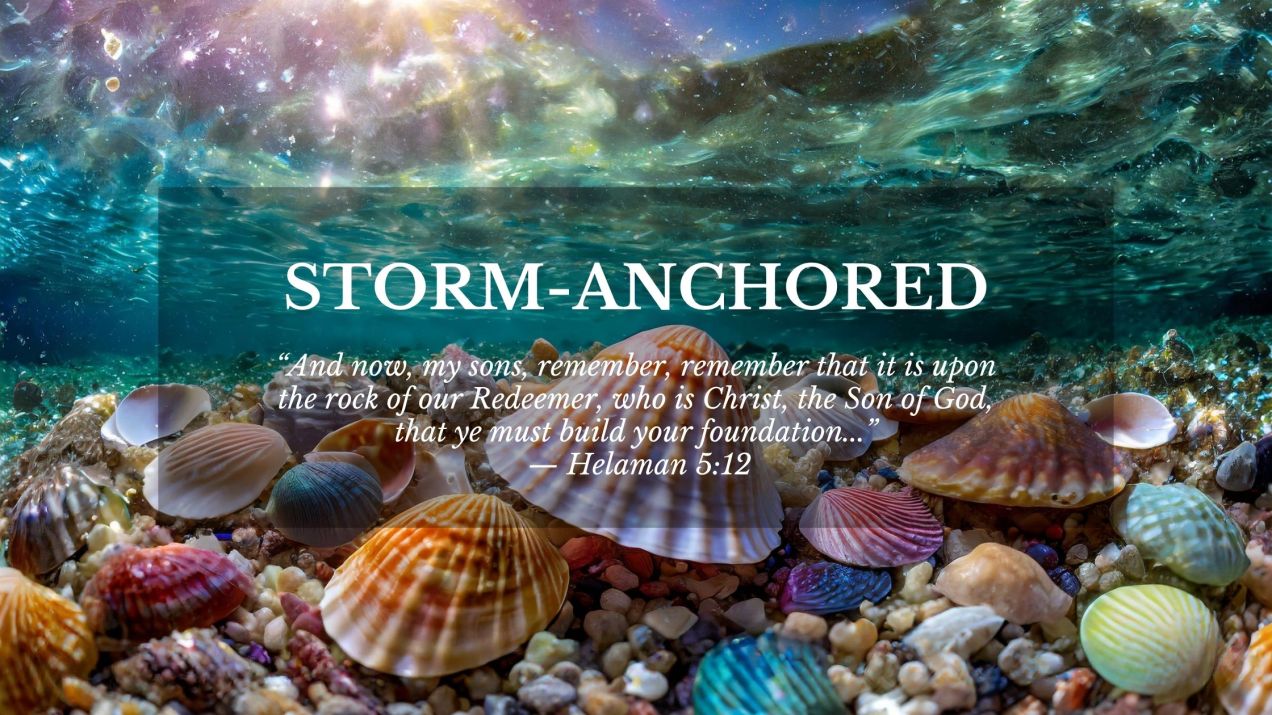
Storm-Anchored

This past Sunday, I was asked to give a talk on three topics for timing purposes. At first, it felt like a challenge, but I put something together, and I have to say — it became one of my favorite talks to deliver. I spent a week practicing and revising it, nearly memorizing every word. I’d like to share it here so we can have a manuscript that reflects my progression. I hope you enjoy it and feel the Spirit as you read. It was also the calmest I have ever felt while speaking.

Good morning, brothers and sisters.

I’m very grateful to be here today and for the opportunity to speak about how we can better anchor our lives in Jesus Christ — through obedience to His commandments and the blessings of the temple.

I’d like to start with a simple question: When you hear the word anchor, what comes to your mind?

Usually, we picture a ship at sea, lowering its anchor so it won’t drift with the waves or the current. An anchor doesn’t stop the water from moving. It doesn’t cancel storms. It simply keeps the ship in place in the middle of them.

What’s remarkable about an anchor is that it’s used before the danger feels real. A ship doesn’t wait until it’s being pushed toward the rocks—it lowers its anchor while the waters still seem calm. So when the storm comes, it already has something holding it in place.

In our own lives, drifting rarely comes from one big, rebellious choice. It usually begins in small, almost invisible ways:

  • Skipped prayers.
  • Rushed Sundays.
  • Quiet doubts.
  • Busy weeks where we forget to pause and look to Christ.

At first, none of it seems serious. But slowly, almost unnoticed, the peace we once felt begins to slip away. And before we realize it, we’ve drifted from the Savior — not because we intended to, but because we didn’t take the small, consistent steps to keep Him at the center of our lives.

That’s why the Book of Mormon teaches us so clearly where our anchor must be. In Helaman 5:12, it reads:

And now, my sons, remember, remember that it is upon the rock of our Redeemer, who is Christ, the Son of God, that ye must build your foundation; that when the devil shall send forth his mighty winds, yea, his shafts in the whirlwind, yea, when all his hail and his mighty storm shall beat upon you, it shall have no power over you to drag you down to the gulf of misery and endless wo, because of the rock upon which ye are built, which is a sure foundation, a foundation whereon if men build they cannot fall.

I love that it doesn’t say if storms come. It says when storms come. In mortality, storms are guaranteed. They come as winds and whirlwinds of disappointment, temptation, heartbreak, confusion, and fear. They are part of being human.

Christ never promised us a storm-free life. But He did promise us a safe foundation.

He isn’t just someone we believe in.
He is someone we build our lives upon.
He becomes the rock beneath our feet when everything else feels uncertain.

So what does it really mean to anchor our lives in Christ?

It means we choose Him before the storm comes.
We remember Him in peaceful days, not only desperate ones.
We build habits of faith when life feels calm, so that when life feels heavy, we already know where to turn.

The blessings of a life built on Christ go beyond protection. They bring peace, clarity, direction, and a quiet assurance that, no matter what happens, we are never alone.

Anchoring our lives in Christ is not just something we feel—it’s something we live.

An anchor only works if it’s actually attached. A ship can admire its anchor, even trust it—but unless it’s dropped into the water and connected to the ground below, it won’t hold the ship in place.

In the same way, believing in Christ alone isn’t enough. Our anchor holds only when we connect our lives to Him through the choices we make every day.

And that connection is obedience.

It’s when belief becomes action.

When love becomes something we practice.

When our relationship with Christ quietly shows up in our schedules, our habits, our words, and the choices we make when no one else is watching.

The Savior taught simply,
 “If ye love me, keep my commandments.

Keeping the commandments is how we stay close to the anchor instead of slowly drifting away from it.

When we obey, we aren’t earning God’s love — we already have that. Instead, we’re positioning ourselves to receive His peace, His protection, and His power.

The Lord teaches this principle in Doctrine and Covenants 130:20–21:

There is a law, irrevocably decreed in heaven before the foundations of this world, upon which all blessings are predicated—And when we obtain any blessing from God, it is by obedience to that law upon which it is predicated.”

Blessings come when our lives align with the laws God has lovingly given us.

The Lord also promises in Doctrine and Covenants 14:7:

If you keep my commandments and endure to the end you shall have eternal life, which gift is the greatest of all the gifts of God.

And in Doctrine and Covenants 82:10, He says:

I, the Lord, am bound when ye do what I say; but when ye do not what I say, ye have no promise.

I love how that is phrased — I, the Lord, am bound. 

When we keep our covenants and commandments, God commits Himself to us because He is faithful to His word.

So what does obedience really look like in everyday life?

  • Keeping the Sabbath day holy when the world tells us to rush.
  • Being honest when cutting corners would be easier.
  • Paying tithing when trust feels stretched.
  • Living the law of chastity and honoring our bodies and relationships as sacred.
  • Choosing kindness, forgiveness, and humility even when emotions push us another way.

Sometimes obedience sounds serious or strict, but it can also be simple, gentle, and even playful.

I say that because a few weeks ago, my brother wanted to go out to watch football with my uncles, so he asked me to go keep my sister-in-law company so she wouldn’t “bother” him. And because I’m clearly his best sister ever, I went over.

They’ve been having lessons with the missionaries, so I decided to have a little family home evening with her and teach her the hand signs for the Ten Commandments that I learned back when I was an investigator. And of course, no lesson is complete without a treat — something I learned years ago teaching Primary — so I brought one of her favorite drinks to keep things happy and light. She knows this, that’s why I’m sharing it. 😛

We went through the commandments one by one using our fingers. It was simple and playful, but it helped make them stick. I do hope she still remembers them so Elders, we might lose our visitation right after today, but please test her when you go back to visit them.

That small moment with her taught me something. Following the Lord isn’t just about rules — it’s about helping each other remember who we belong to. Sometimes it’s one reminder, one conversation, one gentle nudge toward Christ that quietly strengthens someone’s faith.

Keeping the commandments actually increases our freedom.

That might sound strange, because the world often says rules restrict us. But the Lord’s commandments protect us from many of the sorrows we create for ourselves. They keep us from chains we don’t see until we’re already tangled in them.

Lehi’s dream teaches this beautifully. In his vision, people are trying to reach the tree of life, which represents the love of God. Some hold fast to the iron rod and arrive safely. Others let go and wander into the mist and darkness.

The iron rod is the word of God — His teachings, His covenants, and His commandments. Holding fast is choosing Him. Letting go is drifting away.

Those who keep moving forward, even when it’s hard, even when they can’t see clearly, are the ones who arrive at the fruit of peace, love, and joy.

Following Christ isn’t about perfection.

It’s about direction.

It’s about continually turning our hearts toward the Savior and trusting that His way leads to real happiness.

One of the greatest places where that commitment becomes a sacred covenant is the temple.

Every time we choose honesty, faithfulness, humility, and love, we are preparing ourselves to enter the Lord’s house and receive the blessings He wants to give us there.

Recently, I had the sacred opportunity to receive my endowment. When we receive our endowment, we make new covenants that build upon the ones we made at baptism. And though I cannot share all the details of that experience, I will share this:

As I stood in the Celestial Room and looked up at the chandelier above me, I felt what I can only describe as an overwhelming sense of joy — though the word hardly holds it. It swelled in my heart so suddenly and so deeply that I had to pause to keep from crying.

And luckily, sometimes my tears are shy enough to stay in their place when I tell them to.

I felt small, but not insignificant — small in a way that felt protected, seen, and deeply loved. It felt like the world paused for a moment so the Savior could remind me that He is near, aware, and patient with me.

What surprised me most was how beautifully the whole journey unfolded, not just that day, but in the weeks leading up to it. As I prepared for my endowment, I set a personal goal that every third Saturday of the month I would go to the temple to perform ordinances for those who have passed on. I love the early 7 a.m. sessions, so if anyone is ever interested in joining me, I would truly love your company.

The Saturday before the week of my endowment was one of those mornings.

That day, I was helped by a temple worker brother and sister. When they asked if I had already been endowed, I told them I would be the following Saturday, and they rejoiced with me. The sister shared that her husband had been the first president of the Hmong branch in the 1990s. 

It was such a pleasure getting to know her, listening to her stories, and feeling her deep connection to our culture. 

Through those simple conversations, I felt that morning had been prepared for me — that I was meant to be there to meet them.

Then, when the day of my endowment arrived and I approached the veil — which symbolizes Christ, because it is only through Him that we can come into the presence of our Heavenly Father — I was guided forward. And as I was received through, I realized the brother assisting me was the same temple worker I had met the Saturday before.

In that quiet, sacred moment, we recognized each other.

It felt deeply personal. It connected my experience of receiving my own endowment with the ordinances I had been performing for others. And it reminded me that the Savior often works through people. He is aware of the small details of our lives, and He places individuals in our path to gently testify that He is involved in our journey — every step of the way.

Because of that, I also want to thank the brothers and sisters of our ward who were there that day. Not only were you there to show your love, but you were also there to help those who have passed on receive their ordinances. I truly believe the people you served are grateful as well.

I hope that when you went through the veil that day, you felt — or remembered — your own endowment and its blessings, and that you know how deeply you are loved by our Heavenly Father.

When I left the temple, I realized something important: what we feel there isn’t meant to stay inside those walls. It’s meant to follow us home. As I got into my car and sat for a moment, my tears finally greeted the world — a reminder of how deeply blessed I am to belong to something eternal.

My mom used to ask me why people cry when they bear their testimonies. In that moment, I felt like I finally understood why. Sometimes, the Spirit touches us so deeply that words can’t fully contain it. 

Since my family came to church and I let go of the things that no longer served a purpose in my life, I’ve joked that I forgot what it feels like to be sad and to cry, because my days have been full of sunshine even when they’re gray. But that day at the temple didn’t count — those were tears of happiness.

I hope that all who have not yet felt that joy will one day prepare themselves to receive their endowment and seek it — the kind of joy you would want to carry with you always. 

The temple also teaches us how to carry Christ into our choices, our relationships, our patience, and our forgiveness. It strengthens the anchor line between us and the Savior so that when life grows noisy again, we still remember where our center comes from.

When someone hurts us, the temple reminds us to respond with mercy instead of pride. When life feels rushed, it teaches us to pause and listen instead of react. When relationships feel strained, it helps us choose understanding over defensiveness. And when we feel tired or discouraged, the temple brings us back to remembering who we are, who we belong to, and the kind of person we are becoming — someone worthy of being sealed to another for eternity and someone we would want to spend the rest of our lives with.

What settles into our hearts inside the Lord’s house becomes a guide for how we speak, how we serve, and how we love once we step back into the world.

Brothers and sisters, I testify that Jesus Christ is our true anchor. When we build our lives on Him — through obedience, repentance, covenants, and love — we don’t become storm-proof, but we become storm-anchored.

I know He lives.
I know He knows us personally.
And I know that as we choose Him daily, He will steady our hearts, guide our steps, and keep us close to what our souls are searching for.

I say these things in the name of Jesus Christ, amen. 🌸

Standard